The Outboard Expert: Engines Serving Many Masters
North America, Europe,and developing nations utilize the multi-facted outboard engine differently.
In December my father visited a Scouting friend in The Gambia, a tiny nation on the central Atlantic coast of Africa. Surrounded on three sides by Senegal, the Gambia is the smallest country in Africa, essentially the north and south banks of the Gambia River and a 60-mile coastline. Nice beaches attract Spanish tourists in the winter, who rarely venture far from the sound of the surf. But with his local friend, my father had a chance to tour the interior of the country aboard a long wooden boat powered by a Yamaha outboard, which carried them up river. Fish caught in the river and the ocean make up much of the Gambian diet, so a good boat and a reliable outboard motor are prized possessions there that give the owners a significant economic advantage over fishermen in unpowered boats.

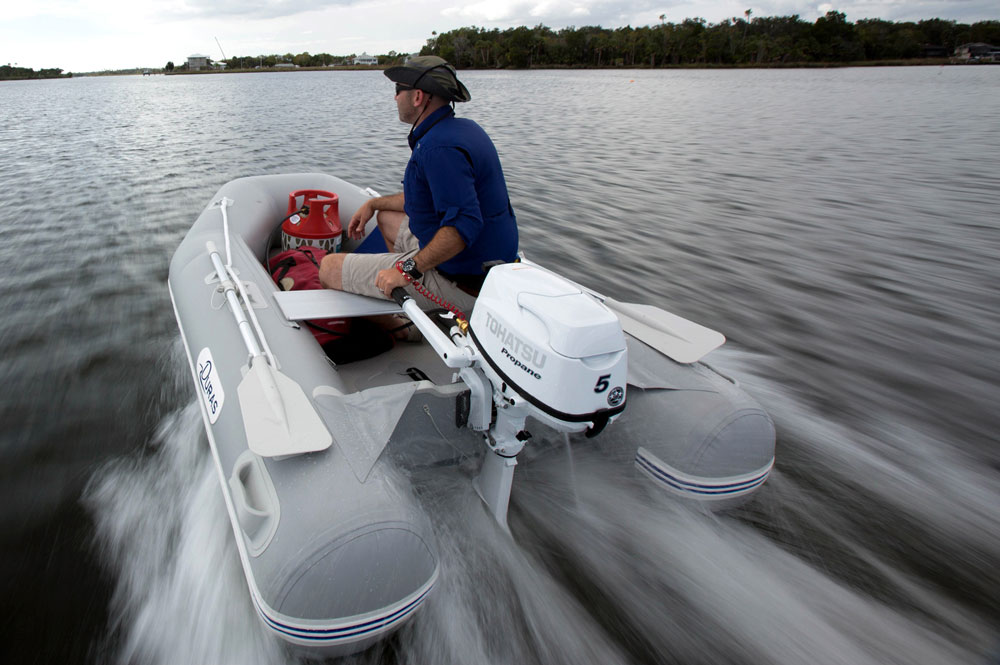
Small outboard motors like this four-stroke Suzuki DF6 power the inflatable boats that are popular in Europe, where high fuel costs and tight emissions regulations influence the market.
His pictures from the trip helped me recall that when I worked at OMC, more than 20 years ago, Evinrude and Johnson were important brands in South America, and OMC had an office in Miami devoted to servicing that market. One of the guys in our office had come from the Miami operation, and had great stories about boating up the Amazon to see how the motors were being used, and how an Amazon boatman would pick up a 55-hp Johnson and carry it home on his shoulder at the end of the day - a portable outboard, indeed.
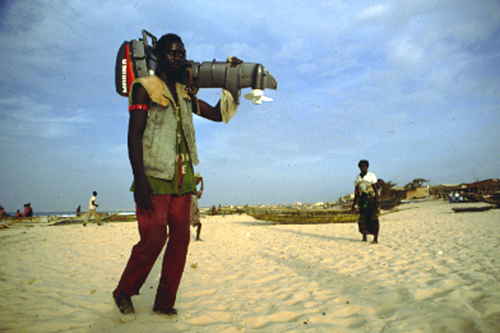
In many developing nations, an outboard motor is a prized possession that gives its owners a significant economic advantage. At the end of the day, it may be carried home for safe-keeping.
From an American viewpoint, it's easy to consider the outboard motor market native to the United States, the country of Evinrude and Kiekhaefer, after all; but the truth is that the combined markets outside the United States are much larger.
"In the recent past, the North American market has accounted for about 35 percent of annual world outboard sales, or about 300,000 of 850,000 units produced," says Randy Caruana, Vice President of Sales at Mercury Marine.
Those markets can generally be divided into the European pleasure-boat market, and the developing economies of the world, where outboards are tools for work. Each market has its peculiarities, driven by economics and local regulations.

Outboard-powered fishing boats on the Atlantic coast of The Gambia in central Africa. In much of the world, an outboard motor is a tool used for work, and survival, not for pleasure (photo by John Werth).
"In the United States last year, the average horsepower of all outboards sold was 90. In Canada, it was 50. In Europe, it was only 25 horsepower," said Caruana. "There are not a lot of bass boats or big center consoles running around Europe with 250-hp motors. It's primarily a market for inflatables of all sizes."
High fuel costs make economy a priority in Europe, and there are many bodies of water with horsepower restrictions, often for environmental reasons. Until just recently, exhaust emissions regulations in Europe were much stricter than those in the United States. The power ratings - expressed in kilowatts - for boats in Europe also do not always match those of models sold in the United States. For example, last year Suzuki introduced a new mid-range motor rated at 70, 80 and 90 horsepower. The 70 and 90 ratings are popular in the U.S. The 80-hp version was for Europe, according to Suzuki. Mercury and Yamaha also offer 80-hp models in Europe. Eighty horsepower coverts to just under 60 Kw, and there are a number of popular boats in Europe with a 60-Kw rating.

Two-stroke Mercury Sea Pro models sold in many parts of the world are designed to be durable and run on low-quality fuels.
Each brand also offers many portable motors for Europe. Mercury portables include an 85cc rated at 2.5- and 3.5-hp, a 123cc rated at 4-, 5-, and 6-hp, and a 209cc rated at 8- and 9.9-hp. Can there be that much difference between the 4 and the 6?
"Just like boaters here, the European customer wants the maximum power on his transom, so when that inflatable is loaded down he can get it moving," said Caruana. "The difference between the 4 and 5 is 25 percent, which maybe means he goes from four to five mph."
In developing markets, like Africa and South America, reliability and low cost are the key selling points for an outboard. There are usually no environmental regulations, so the light-weight, dirt-simple carbureted two-stroke motor remains popular. Yamaha is the market leader where carb two-strokes are still sold. Suzuki builds two-stroke from 9.9 to 40 hp, including several that will run on kerosene. Mercury still manufactures carb two-strokes strictly for export. Often these motors are designed specifically to thrive in third-world conditions.
"We sell a Mercury Sea Pro line of motors, which are intended for commercial use in these markets," said Caruana. "They have more corrosion-resistant, stainless steel components, and are designed to require minimal maintenance and run on very low-quality fuel. And they are easy to carry. You might notice than all Mercury motors have a curved shape to the back side of the mid-section, and that's not for aesthetics. It's so it rides comfortably on your shoulder."
The better to get baby safely home at night.